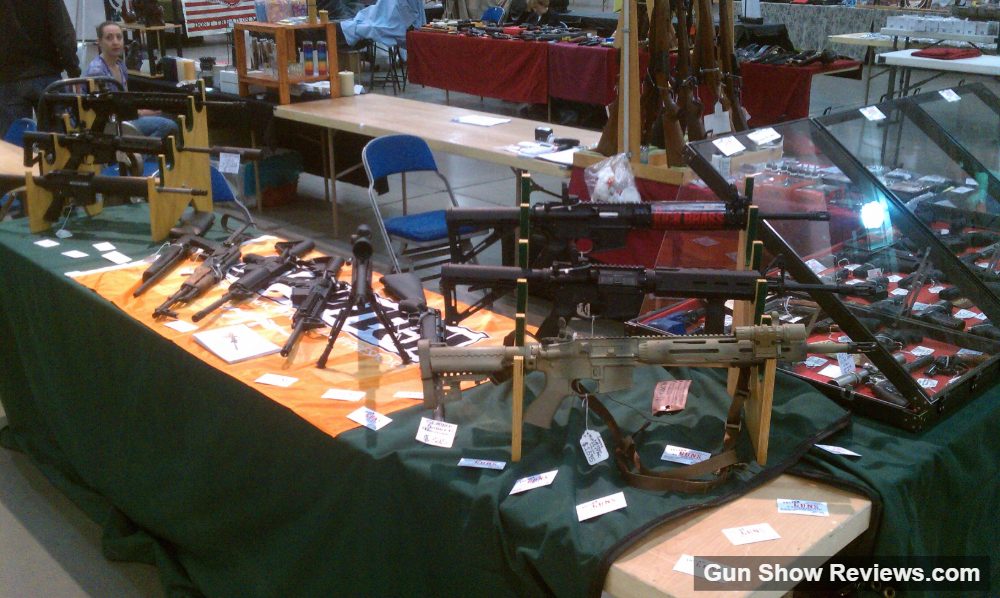
Buying or selling at a gun show follows the same laws as anywhere else, but the rules depend on who is selling. A licensed dealer at a gun show table runs the same paperwork and background check as in a store. A private collector selling from a personal collection follows federal private-sale rules, plus whatever the state adds. This page sorts out the basics.
Gun Show Laws at a Glance
| Licensed Dealers (FFLs) | Form 4473 and a NICS background check, same as in a store |
|---|---|
| Private Sellers, Same State | No federal background check required; some states require one |
| Private Sellers, Other State | Must transfer through a licensed dealer in the buyer’s state |
| Minimum Age at a Dealer | 18 for long guns, 21 for handguns (courts are split) |
| State Laws | Vary widely, so check the state where the show is held |
Licensed Dealers at Gun Shows
Federal Firearms Licensees can sell at gun shows in their own state. Every sale they make there follows the same rules as their storefront: the buyer fills out ATF Form 4473, the dealer runs the buyer through the FBI’s National Instant Criminal Background Check System (NICS), and any state waiting periods or permit rules still apply.
Private Sales and the “Gun Show Loophole”
Federal law does not require a background check when a private person, someone not in the business of dealing guns, sells a firearm from a personal collection to a resident of the same state. That rule applies everywhere, at a gun show, a range or a kitchen table. Critics call it the “gun show loophole.” Supporters point out it is not a gun show rule at all, but the general law on private sales between individuals.
A private seller still may not knowingly sell to someone legally barred from owning a gun, and may not sell directly to a resident of another state. Interstate transfers have to go through a licensed dealer in the buyer’s home state.
Who Counts as a Dealer
The line between a private collector and a dealer has shifted in recent years. The Bipartisan Safer Communities Act of 2022 changed the federal definition of being “engaged in the business” of dealing firearms to anyone who sells to “predominantly earn a profit.” In 2024, ATF issued a rule expanding on that definition. A federal court in the Northern District of Texas vacated that 2024 rule in its entirety on June 12, 2026, and ATF has proposed a replacement that keeps the definition Congress wrote in 2022.
State Laws
Many states add their own rules on top of federal law. Some require a background check on every sale, including private sales at gun shows; others require one only for handguns or only at gun shows; many follow the federal rules alone. Waiting periods, permit-to-purchase systems and limits on certain guns and magazines also vary by state. Check the law in the state where the show is held before buying or selling.
Show Rules
Promoters set their own rules on top of the law. At most shows, guns brought in to sell or trade are checked at the door, unloaded and secured with a zip tie, and loaded magazines stay outside. Expect to show identification, and read the posted rules before walking in.
Gun Show Laws on Video
State Level Background Checks, Maps of 2A
Number of FFLs, Maps of 2A
This page is general information, not legal advice. Laws change, so confirm current federal rules with ATF and state rules with the state attorney general or state police before a sale.
More on the shows themselves is in the Gun Show Resources section and on the F.A.Q. page.